
For cooperative societies, compliance is not just an obligation—it is the foundation of trust and continuity. Parameterized CBS for regulatory compliance enables institutions to respond to registrar and cooperative department requirements without operational disruption.
However, regulatory frameworks are not static. Rules related to asset classification, reporting formats, risk assessment, KYC norms, and audit requirements are frequently updated. For institutions operating on rigid or legacy Core Banking Systems (CBS), every regulatory change often triggers manual interventions, system workarounds, or expensive software modifications.
This is where a parameterized Core Banking System plays a transformative role. By allowing business rules and reporting logic to be configured without altering core code, a parameterized CBS simplifies compliance, reduces operational strain, and ensures institutions remain audit-ready at all times.
Understanding a Parameterized CBS for Regulatory Compliance
A parameterized CBS is designed to separate business rules from system code. Instead of embedding regulatory logic directly into the software, the system allows authorized users to define, modify, and manage rules through configurable parameters.
In practical terms, this means changes to interest calculations, asset classification rules, reporting thresholds, or product conditions can be implemented through system configurations rather than development projects. This flexibility is especially critical in environments where regulatory expectations evolve frequently.
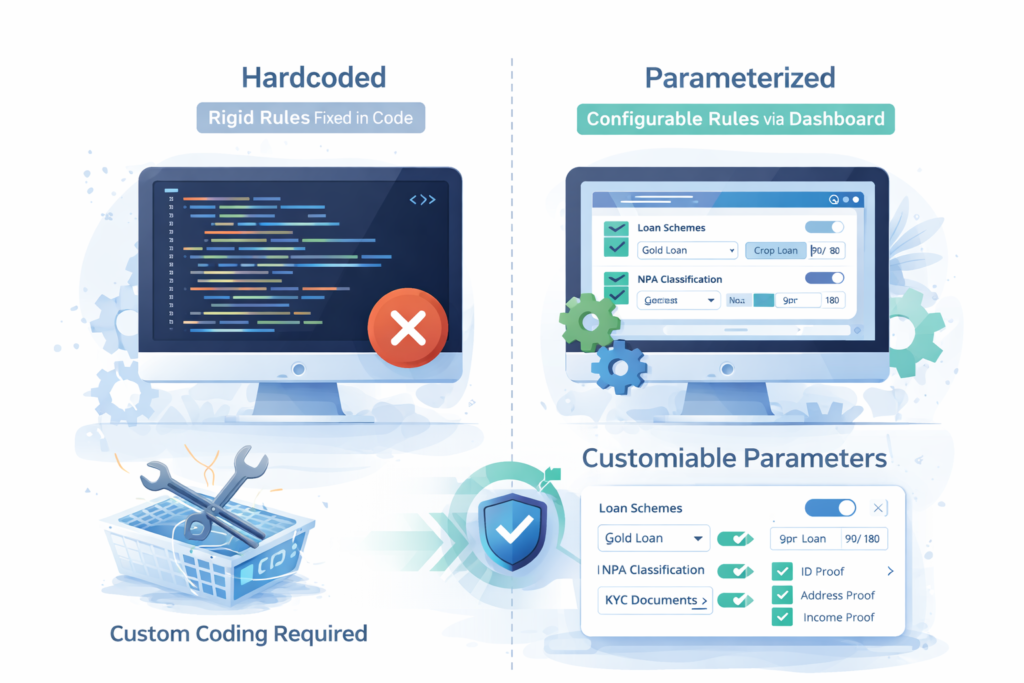
Rigid Systems vs. Parameterized CBS: A Practical Comparison
| Aspect | Rigid / Legacy CBS | Parameterized CBS |
|---|---|---|
| Regulatory Changes | Requires vendor intervention and code changes | Implemented instantly by updating system parameters |
| Reporting Readiness | Manual data compilation and reconciliation | Automated, system-generated regulatory reports |
| Product Configuration | New schemes require custom development | Products configured using predefined parameters |
| Audit Trail | Fragmented logs across systems | Centralized, real-time audit logs |
| Compliance Risk | Higher due to manual overrides | Lower due to uniform rule enforcement |
This contrast highlights why flexibility is no longer a convenience but a necessity for compliance-driven operations.
Key Parameterized CBS Features for Regulatory Compliance
1. Dynamic Asset Classification for Regulatory Compliance
Regulatory definitions for asset classification, such as identifying non-performing assets (NPAs), are subject to change. A parameterized CBS allows these thresholds—such as overdue days or provisioning percentages—to be configured centrally.
Once updated, the system automatically applies the revised rules across the entire portfolio in real time. This ensures consistent classification, eliminates manual interpretation, and significantly reduces the risk of non-compliance.
2. Configurable Product Controls in a Parameterized CBS
Financial institutions often offer multiple deposit and lending products, each governed by specific internal policies and regulatory limits. Parameterization enables institutions to define these products by configuring parameters such as interest calculation methods, penalty structures, exposure limits, and tenure rules.
As a result, every product operates within approved compliance boundaries from the moment it is launched, without requiring additional system customization.
3. Automated Regulatory Reporting with Parameterized CBS
One of the most time-consuming aspects of compliance is regulatory reporting. Preparing statutory returns, surveillance reports, and audit submissions often involves manual data extraction and reconciliation across systems.
A modern parameterized CBS includes an automated reporting engine that pulls data directly from a centralized database and formats it according to prescribed regulatory structures. Reports can be generated on demand, improving accuracy, timeliness, and confidence during submissions.
Strengthening Audit Readiness with Parameterized CBS
Compliance extends beyond report generation—it also requires institutions to demonstrate that all transactions and decisions followed approved rules.

Centralized Data Consistency
By enforcing uniform parameters across branches and digital channels, a CBS ensures that operational rules are applied consistently. This eliminates discrepancies that commonly arise in fragmented or semi-manual systems.
Comprehensive Audit Trails
Every parameter change, transaction, and approval is logged with timestamps and user identification. Auditors can trace not only what occurred, but also which rule governed the action at that time. This level of transparency significantly reduces audit effort and response time.
Compliance as a Strategic Advantage
A parameterized CBS does more than simplify regulatory reporting—it embeds compliance into daily operations. Institutions gain the agility to adapt quickly to regulatory changes while maintaining strong internal controls and data integrity.
This shift allows management teams to spend less time responding to compliance pressures and more time focusing on service quality, operational efficiency, and sustainable growth.
Take the Next Step
Regulatory complexity will continue to grow, but managing compliance does not have to become harder.
Discover how SmartCBS uses parameterized core banking features to simplify regulatory reporting, improve audit readiness, and embed compliance into everyday operations.
